

How to Choose the Right Outdoor SF6 110kV Tank Circuit Breaker?
Planning a new 110kV substation project or replacing aged switchgear? The switching equipment you choose directly shapes grid reliability, maintenance workload and personnel safety. If your station sits outdoors in a polluted, humid or coastal climate, this guide explains what to check when evaluating an outdoor SF6 110kV tank circuit breaker, and why the sealed tank design is often the preferred solution for exposed high-voltage installations.
Why the Sealed Tank Design Works Outdoors
An outdoor high-voltage breaker must keep its interrupting chamber protected from rain, dust, salt spray and condensation all year round. In a tank-type unit, the interrupters and insulating gas are housed inside a welded steel tank, while the phase bushings rise above the enclosure to connect with overhead lines or cables. This arrangement keeps the live parts away from airborne pollution, reduces the chance of surface flashover, and leaves a compact footprint that fits most existing substation layouts. The tank and mechanism cabinet are finished with an anti-corrosion coating so the unit can withstand wind, rain and temperature swings without frequent repainting.
Five Criteria to Verify Before Specifying the Unit
Before comparing quotes, confirm these rated parameters against your system study:
1.Rated voltage and insulation level — typically the 126kV class for a 110kV network, with power-frequency and impulse withstand values matching the applicable standard.
2.Rated normal current and short-circuit breaking current — chosen above the maximum fault level expected over the station's service life.
3.Mechanical and electrical endurance of the interrupting chamber, together with the reliability of the spring operating mechanism.
4.SF6 gas density monitoring, pressure alarms and leak-tightness records, because sealed gas insulation is the core of this design.
5.Enclosure protection class, auxiliary contacts, local/remote control interface and compliance with IEC 62271-100 or the equivalent national standard.
You can review the full range of switchgear in our high-voltage circuit breaker category.
How Our Unit Is Built and Tested Before Shipment
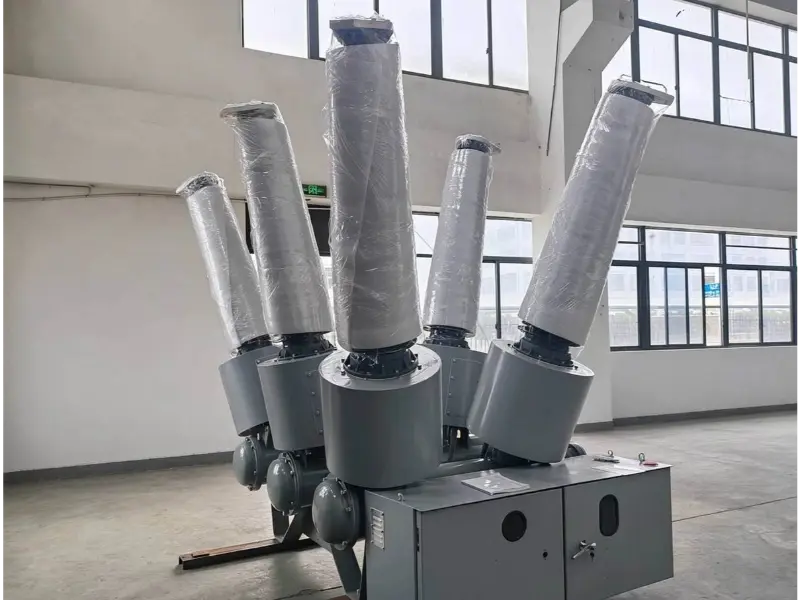
Tank-type breaker after final assembly, awaiting factory inspection and packing; phase bushings are wrapped in protective film to prevent transit damage.
Our outdoor SF6 110kV tank circuit breaker combines a welded SF6 tank, epoxy-insulated bushings, an integrated spring mechanism cabinet and a common steel base frame. Before shipment, each unit passes gas leak testing, mechanical operation checks and factory inspection; the phase bushings stay wrapped in protective film, as shown in the photo, to avoid scratches or impact damage during transport. The mechanism cabinet provides local open/close control, auxiliary signaling and terminals for remote substation automation, so the breaker can be integrated into both conventional and intelligent stations.
Typical Applications and After-Sales Support
This type of breaker is widely used in 110kV transmission and distribution substations, large industrial plants, and step-up stations for wind, solar and energy-storage projects. Our engineering team can supply rated data, general arrangement drawings, secondary wiring diagrams and commissioning guidance, and we keep spare parts and mechanism components available for after-sales service. For a detailed offer, visit the product page of the outdoor SF6 110kV tank circuit breaker or send your one-line diagram and fault-current data for a tailored proposal.
Conclusion: Match the Breaker to Your System, Not Only to the Voltage Nameplate
Selecting the right outdoor SF6 110kV tank circuit breaker is about more than matching a nameplate voltage: it means verifying breaking capacity, sealed gas insulation, corrosion protection and local support. Compare the figures above against your system requirements, and contact our sales engineers for a tailored quotation, technical drawings and a factory inspection schedule.